Construction costs in the UAE have risen by an estimated 3.3% in tender price inflation for 2025 — and 2026 is tracking another 2.7% increase on top of that. For contractors working on fixed-price contracts, that is not an abstraction. It comes directly out of margin.
The UAE construction market reached USD 42.75 billion in 2025 and is expected to grow to USD 52.66 billion by 2030. That scale means the stakes around cost control are rising alongside the cranes. Even a 2–3% cost variance on a mid-size project in Dubai or Abu Dhabi translates to hundreds of thousands of dirhams in losses — losses that don’t always show up until the project is already over.
The companies that are protecting margins today are not doing it by negotiating harder or hoping material prices stabilize. They’re doing it by building visibility into their cost execution before overruns become irreversible.
Construction cost escalation is the increase in actual project costs beyond what was originally budgeted or contracted, due to factors that emerge during execution. It is not the estimate that fails. It is the gap between what is estimated and what can be seen, tracked, and controlled in real time.
In the UAE, several structural forces are compounding this problem simultaneously.
Labour costs rose an estimated 15% between 2024 and 2025, driven by stricter health insurance requirements and tightening Emiratisation quotas. The pool of qualified contractors is shrinking at the same time as project complexity is growing, which means contractors in specialist trades are securing better terms — and the cost lands on whoever has a lump-sum contract.
Procurement timelines are tightening. With AED 143 billion in contract awards recorded in Q1 2025 alone, the supply chain is under pressure. Lead times on specialist materials and equipment are extending, and delayed procurement decisions during execution become cost escalation events.
Fixed-price contracts shift all of this risk to the contractor. Single-stage tendering remains the dominant procurement method in the UAE because it gives clients cost certainty. The contractor absorbs the uncertainty. When visibility into cost behavior is delayed, there is no time to act.
Profit margins on mid- to large-scale UAE construction projects currently range from 8% to 12%, according to Turner & Townsend’s 2025 UAE Market Intelligence report. That figure sounds reasonable until you consider what erodes it.
A 3–5% cost overrun on materials — entirely plausible given current bitumen and polymer price behavior — consumes a third to half of that margin. A labour productivity gap, one delayed approval cycle, one procurement decision made on gut feel rather than vendor comparison data, and the project stops being profitable before it reaches handover.
The competitive pressure compounds this. Tendering competition has modestly declined as the pool of contractors capable of handling specialist work shrinks — but that same pressure has not reduced the number of projects. The pipeline of UAE construction activity stands at USD 772 billion. Companies that want to win and deliver work profitably need a structural advantage in how they control costs, not just how they bid.
Here is what the visibility gap looks like in practice:
A site team raises a material indent. It routes through procurement, gets partially approved, then sits in an email queue while someone checks the budget. By the time finance reconciles the PO against the committed budget, two weeks have passed. The cost was always there — it simply wasn’t visible to the person who could have acted on it.
Multiply that delay across subcontractor billing cycles, across material categories with independent price movements, across five active project sites — and the margin that looked acceptable at tender is already compromised by the time the first MIS report lands on the CFO’s desk.
The problem is not that companies lack data. It is that the data arrives after the decisions have already been made.
This alone changes the conversation from “why did we overspend?” to “we’re approaching the threshold — what do we do now?”
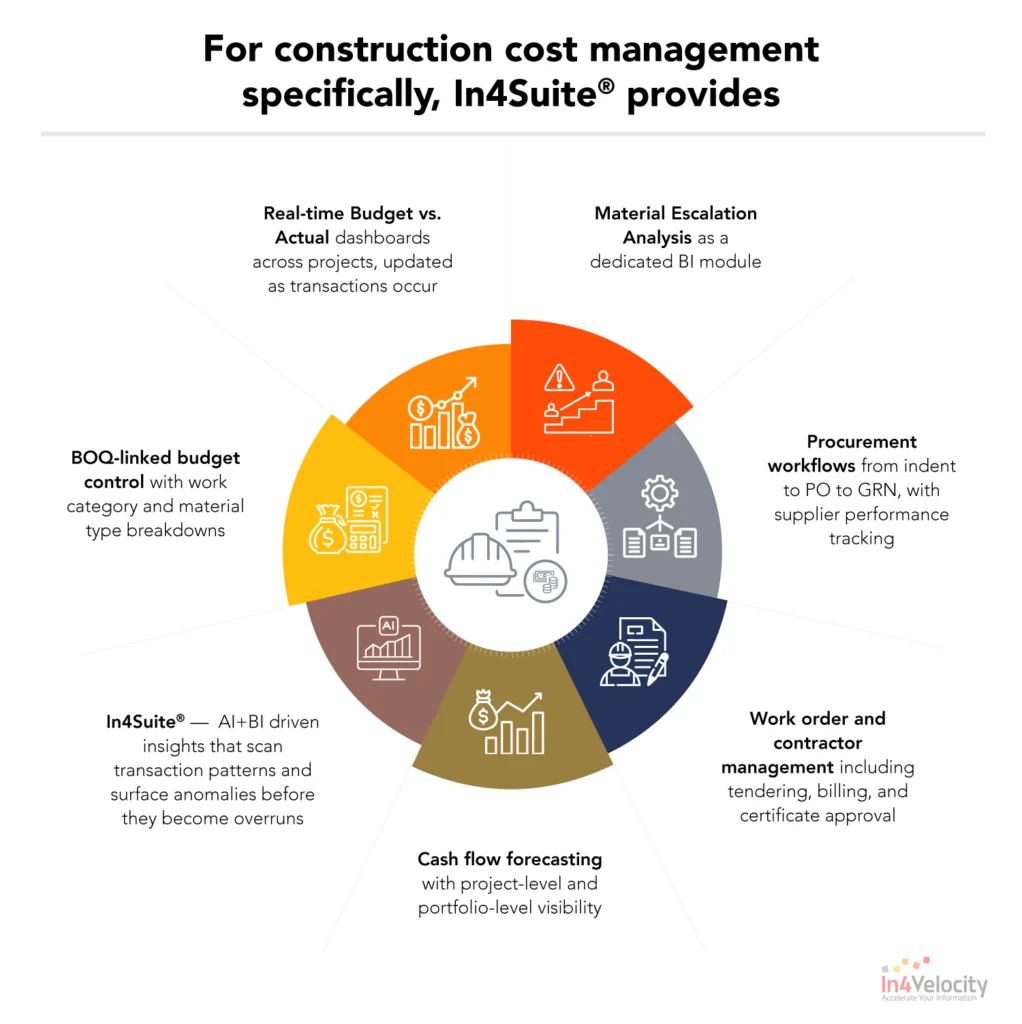
Knowing what has been spent is useful. Knowing what remains to be spent — and whether that number is moving — is where the real control lies. Dynamic cost-to-complete projections, updated as site progress, variations, and procurement decisions are recorded, give leadership a forward view rather than a historical one.
Early warning thresholds can be configured so that budget alerts surface before overruns happen, not after.
One of the highest-leverage areas for cost control is procurement. The ability to compare vendor quotes against historical pricing, flag off-contract purchases, consolidate indents across similar materials, and track supplier performance — all within the same system where budgets live — eliminates a significant source of cost leakage.
Material escalation analysis across project categories gives procurement teams the intelligence to buy strategically, not reactively.
In4Suite® also brings a natural language interface — users can query their project cost data in plain English through Microsoft Teams or WhatsApp, and receive actionable responses. This is not a reporting enhancement. It is a change in how quickly decision-relevant information reaches the people who need it.
Clients like DRA Homes, Vensa Infrastructure, and Ark Constructions — operating across different scales and geographies — have used In4Suite® to replace disconnected processes with integrated visibility. As Bharat Kerai, Director at Ark Constructions, put it: the platform provided a birds-eye view of all operational activities that their business had been looking for across two years of market evaluation.
To make this concrete: a contractor running four simultaneous projects across Dubai and Abu Dhabi — each on a lump-sum contract — faces the following risk exposures right now:
Without an integrated system, each of these exposure areas requires a separate monitoring effort — Excel sheets, emails, periodic calls, manual reconciliation. Overruns are discovered at month-end or at project close.
With an integrated system, each of these exposure areas generates a transaction that flows into the same budget model in real time. The finance team sees committed costs before they become actuals. The procurement team gets vendor comparison data before issuing POs. Site managers see budget utilization before indents become commitments.
The outcome is not just better reporting. It is earlier decisions — and earlier decisions on cost are the only ones that actually change project profitability.
The companies that will consistently protect margins are those that have operational visibility into cost behavior while there is still time to act. Not at month-end. Not at project close. During execution — when decisions about procurement, subcontractor billing, and scope variations still have an impact on the final number.
Cost control in 2026 is not a finance function. It is an operational capability — and the technology to build it is available and proven.